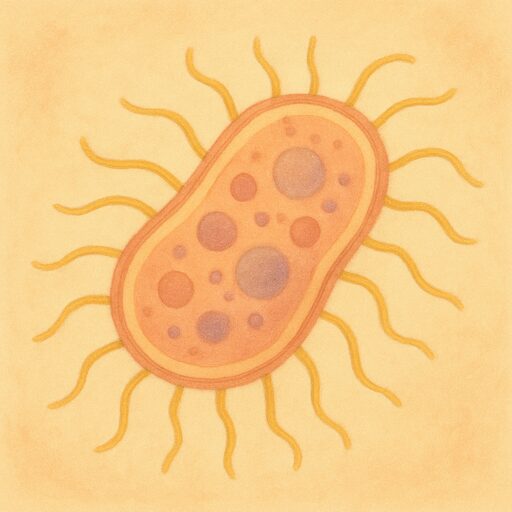
Antonie van Leeuwenhoek was a Dutch man who lived in the 1600s and early 1700s. He is known for being one of the first people to carefully observe very small living things. These tiny forms of life could not be seen with the naked eye. The naked eye means what a person can see without tools. Leeuwenhoek used simple microscopes that he made himself. Through these tools, he observed a hidden world of life that had not been clearly described before. His work helped expand human knowledge of nature at a very small scale.
Antonie van Leeuwenhoek was born in 1632 in the city of Delft, in the Dutch Republic. He did not attend a university or receive formal scientific training. Instead, he worked as a cloth merchant. A merchant is a person who buys and sells goods. In his work, he used magnifying lenses to examine cloth quality. This experience led him to become skilled at grinding and polishing small glass lenses. Over time, he began using these lenses to look at other objects, such as drops of water and scrapings from teeth.
Leeuwenhoek’s microscopes were very simple. Each microscope usually had only one small lens mounted in a metal frame. The object being studied was placed close to the lens. Although simple in design, his microscopes could magnify objects many times. Magnify means to make something appear larger. His lenses were stronger than many others of his time. With them, he saw tiny moving organisms in water. He called these creatures “animalcules,” meaning small animals.
Among the things Leeuwenhoek observed were bacteria, protozoa, and sperm cells. Bacteria are very small living organisms found almost everywhere. Protozoa are single-celled organisms that can move and live in water. Leeuwenhoek was careful in describing what he saw. He wrote detailed letters explaining the shape, movement, and number of these organisms. He sent many letters to the Royal Society in London. The Royal Society was an early scientific group that shared research and ideas.
At first, some members of the Royal Society doubted Leeuwenhoek’s claims. They had never seen such tiny life before. To confirm his work, the Society asked other observers to repeat his observations. When they did, his findings were supported. Leeuwenhoek continued his studies for many years. He observed blood cells, muscle fibers, and tiny organisms in rainwater and pond water. He recorded changes over time and compared samples from different places.
Antonie van Leeuwenhoek lived to be 90 years old and died in 1723 in Delft. During his lifetime, he made hundreds of microscopes, though only a few still exist today. He did not publish books, but his letters remain an important record of his work. Leeuwenhoek is remembered as a careful observer who revealed a hidden world of microscopic life. His observations marked an early stage in the study of microbiology, the study of very small living organisms.
Antonie van Leeuwenhoek
Level
readlittle.com
Early observer of microscopic life
What We Can Learn
- Lived from 1632 to 1723 in the Dutch Republic
- Built simple but powerful microscopes
- First to describe many microorganisms
- Shared observations through detailed letters