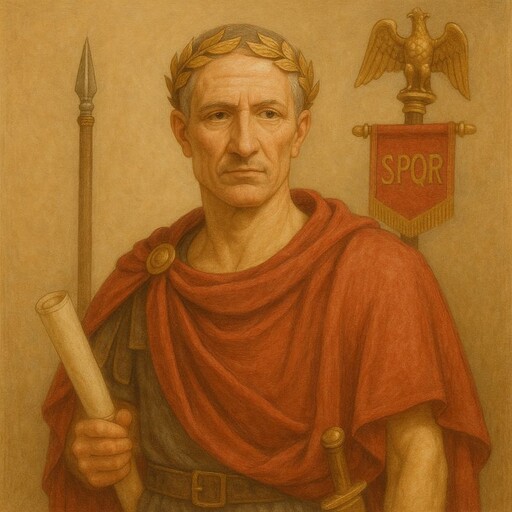
The Gallic Wars were a group of military campaigns fought by the Roman Republic in the region called Gaul from 58 BCE to 50 BCE. Gaul was a large area covering much of modern France, Belgium, and parts of nearby countries. The wars were led by the Roman general Julius Caesar. During these years, Roman armies fought many Gallic tribes. The result was that Gaul came under Roman control.
At the time, Gaul was not a single country. It was home to many tribes, each with its own leaders and customs. Some tribes traded with Rome, while others resisted Roman influence. Caesar was appointed governor of nearby Roman provinces and was given command of Roman legions, which were large units of trained soldiers. He used conflicts between tribes as reasons to move his army into Gaul.
One of the earliest events was the movement of the Helvetii, a Gallic tribe that tried to migrate across Roman lands. Caesar stopped them and defeated their army. After this, fighting spread across much of Gaul. Roman legions fought tribes such as the Belgae in the north and groups along the Atlantic coast. Caesar often built forts and camps to control land and supply his army.
The most famous Gallic leader during the wars was Vercingetorix, a chief of the Arverni tribe. In 52 BCE, he united several tribes to resist Rome. This led to major battles, including the siege of Alesia. A siege is a military action where an army surrounds a town to cut off supplies. At Alesia, Caesar’s forces surrounded Vercingetorix, while also defending themselves from other Gallic armies. After weeks of fighting, Vercingetorix surrendered.
Caesar wrote about the wars in a book called Commentaries on the Gallic War. In this work, he described battles, tribes, and geography. The writing was clear and direct and was meant for Roman readers. These accounts are one of the main sources of information about the Gallic Wars, though they show events from Caesar’s point of view.
After the wars ended, Gaul became part of the Roman Republic. Roman laws, roads, and towns spread across the region. Many Gallic people later became Roman citizens. The Gallic Wars also increased Caesar’s power and fame. This later led to conflict between Caesar and other Roman leaders, which caused a civil war in Rome.
Gallic Wars
Level
readlittle.com
Roman wars in ancient Gaul
What We Can Learn
- The Gallic Wars lasted from 58 BCE to 50 BCE
- They were led by Julius Caesar
- The wars took place in ancient Gaul
- Gaul became part of Roman territory