Olympus Mons is a very large volcano on the planet Mars. It is the tallest known volcano in the solar system, rising about 22 kilometers above the Martian surface. A solar system is a group of planets and other objects that orbit a star. Olympus Mons is much taller than Mount Everest on Earth and covers a very wide area, showing that Mars once had strong volcanic activity.
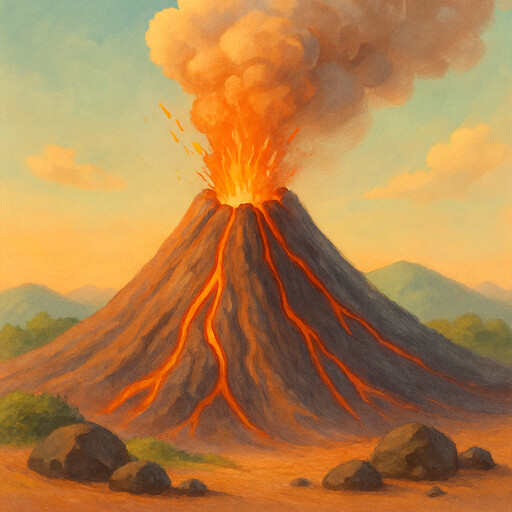
Olympus Mons is a shield volcano. A shield volcano has wide, gentle slopes formed by many thin layers of lava. Lava is melted rock that comes out of a volcano during an eruption. Because the lava at Olympus Mons flowed smoothly and spread far from the source, the volcano grew outward as well as upward. Its slopes are so gentle that a person standing on them might not notice climbing a volcano.
The base of Olympus Mons is extremely large. It covers an area close to the size of the U.S. state of Arizona. Around the base is a steep cliff called a scarp. A scarp is a sharp drop in the ground. Scientists think the scarp may have formed when the heavy volcano pressed down on the surface of Mars and caused the edges to break and sink.
Olympus Mons grew over billions of years. One important reason for its great size is that Mars does not have moving tectonic plates. Tectonic plates are large pieces of a planet's outer shell that move very slowly over time. On Earth, shifting plates carry volcanoes away from their heat source, but on Mars the crust stays in one place. This allowed many eruptions to occur in the same location, building the volcano higher and wider with each event.
At the top of Olympus Mons is a large caldera. A caldera is a bowl-shaped hollow formed when the top of a volcano collapses after an eruption. The caldera at Olympus Mons contains several smaller hollows, which shows that the volcano erupted many times in its past. The exact age of its last eruption is not known, but the surface appears relatively young compared with other parts of Mars.
Olympus Mons provides information about Mars' geological history. Its shape, height, and wide lava flows show how heat and pressure once moved inside the planet. The volcano also helps scientists understand how surfaces change when there is no strong atmosphere or weather to erode them. By studying Olympus Mons, researchers gain clues about volcanic activity and surface processes on Mars over long periods of time.
Olympus Mons
Level
readlittle.com
The tallest volcano on Mars
What We Can Learn
- Olympus Mons is the tallest known volcano in the solar system.
- It is a shield volcano formed by long, smooth lava flows.
- Mars' lack of moving tectonic plates allowed it to grow very large.
- Its caldera shows evidence of many ancient eruptions.