The Qin dynasty was the first dynasty to unite most of China under one central government. A dynasty is a line of rulers from the same family. The Qin dynasty ruled from 221 BCE to 206 BCE. Although it lasted for a short time, it had a strong influence on Chinese history. The name "China" is believed to come from the word "Qin." The dynasty began when the state of Qin defeated other rival states at the end of a long period of wars.
Before the Qin dynasty, China was divided into many states during a time called the Warring States period. These states often fought each other. The state of Qin was located in the west and grew powerful through strict laws and a strong army. In 221 BCE, the Qin ruler Ying Zheng defeated the last rival state. He declared himself Qin Shi Huang, which means "First Emperor of Qin." This marked the beginning of imperial rule in China.
Qin Shi Huang ruled as an emperor, a ruler with complete authority. He ended the old system of feudal rule, in which land was controlled by local nobles. Instead, he divided the empire into regions governed by officials appointed by the central government. He also made many systems the same across the empire. These included standard weights, measures, coins, and writing. Standardization means making things uniform so they can be used the same way everywhere.
The Qin government followed a political idea called Legalism. Legalism taught that people needed strict laws and strong punishment to keep order. Under this system, laws were written clearly, and punishments were harsh. Many people were forced to work on large building projects. These projects included roads, canals, and parts of the Great Wall. The Great Wall was built to defend the empire from northern tribes. It connected older walls built by earlier states.
Qin Shi Huang also ordered the burning of many books. These books included historical and philosophical writings that did not support Legalism. He wanted to control ideas and prevent opposition. At the same time, he built a large underground tomb for himself. This tomb is famous for the Terracotta Army. The Terracotta Army is a group of thousands of life-sized clay soldiers buried near the tomb. They were meant to guard the emperor in the afterlife.
The Qin dynasty ended soon after the death of Qin Shi Huang in 210 BCE. His successors were unable to control the empire. Heavy taxes, forced labor, and strict laws led to rebellions. In 206 BCE, the dynasty collapsed, and a new dynasty, the Han dynasty, took power. Even though the Qin dynasty was short-lived, its systems of government and unification shaped later Chinese history.
Qin dynasty
Level
readlittle.com
First imperial dynasty of China
What We Can Learn
- The Qin dynasty was the first to unite China.
- Qin Shi Huang was the first emperor of China.
- The dynasty created standard systems across the empire.
- It ended due to rebellion and unrest.
Related Reads
No image
Monarchy
Government ruled by a royal family
Thomas Jefferson
Author and third U.S. president
Totalitarianism
A system of complete state control
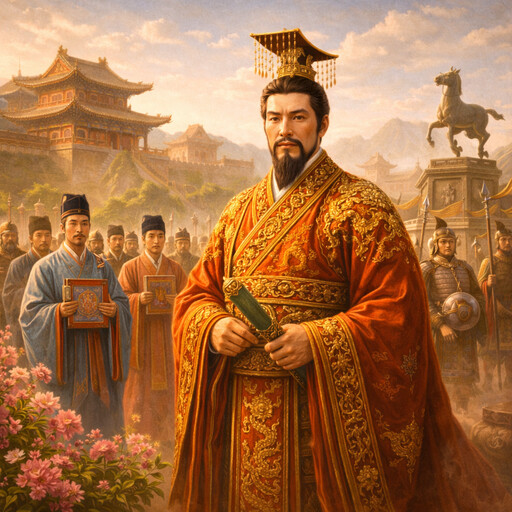
Han dynasty
Long-lasting dynasty of ancient China

Nationalism
Idea linking people to a shared nation
Jeremy Bentham
British thinker on law and society
Montesquieu
French thinker on laws and government

Jean-Jacques Rousseau
Enlightenment writer on society and government

John Locke
Thinker who wrote about mind and government

Thomas Cromwell
Chief minister to King Henry VIII

Athens
Ancient city of Greece
Ottoman Empire
A long-lasting empire across three continents