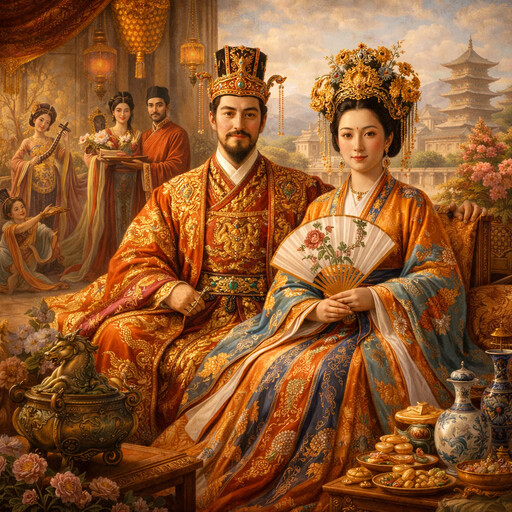
The Song dynasty was a ruling dynasty in China from 960 to 1279. It followed the Tang dynasty and governed large parts of East Asia. The Song period is often divided into two parts, the Northern Song and the Southern Song. During this time, China had a stable government, growing cities, and active trade.
The Song dynasty began when Emperor Taizu took power in 960. He was a military leader who brought different regions under one rule. The capital of the Northern Song was Kaifeng, a large city in northern China. The government relied on trained officials chosen through exams. These exams tested knowledge of Confucian texts, which guided ideas about order and rule.
In the early 1100s, northern China was invaded by the Jurchen people. As a result, the Song court moved south. This period is called the Southern Song. The new capital was Hangzhou. Although the dynasty lost northern land, it continued to govern the south. Southern China became more important for farming, trade, and culture.
The Song dynasty is known for economic growth. Farmers used new tools and methods to increase food production. Rice grown in the south became a main food. Cities expanded as people moved for work and trade. Merchants sold goods such as silk, tea, and ceramics. The use of paper money increased because it was easier than carrying metal coins.
Many important technologies developed during the Song period. Printing using movable type made books easier to produce. The compass helped sailors navigate at sea. Gunpowder was first used in weapons such as fire arrows. These inventions spread to other regions over time. Science and engineering were supported by the government and scholars.
The Song dynasty ended in 1279 when the Mongols defeated the Southern Song. The Mongols later founded the Yuan dynasty. Even after its fall, the Song dynasty remained important in Chinese history. Its government system, cities, and technologies influenced later periods in East Asia.
Song dynasty
Level
readlittle.com
Chinese dynasty of innovation and growth
What We Can Learn
- The Song dynasty ruled China from 960 to 1279.
- It had Northern and Southern periods.
- Trade and cities expanded during this time.
- New technologies were developed and used.
Related Reads

Smartphone
Mobile phone with advanced computing features

Internet
Global network connecting computers worldwide
Qin dynasty
First imperial dynasty of China
Han dynasty
Long-lasting dynasty of ancient China
Industrial Revolution
Shift from hand tools to machines

Gunpowder
Early explosive material
Silk Road
Ancient trade routes across continents
Tang dynasty
Powerful empire of medieval China

Innovation
Creating new ideas or solutions
Patent
A legal right for new inventions
Invention
Creating new things to solve problems

Data
Information collected and used for understanding