Ancient Greece was a civilization that developed around the eastern Mediterranean Sea. It existed from about 3000 BCE to 146 BCE. This long period included early villages, powerful city-states, and later foreign rule. Ancient Greece was not one single country. It was made up of many independent communities called city-states. A city-state was a city and the land around it, ruled as a separate unit.
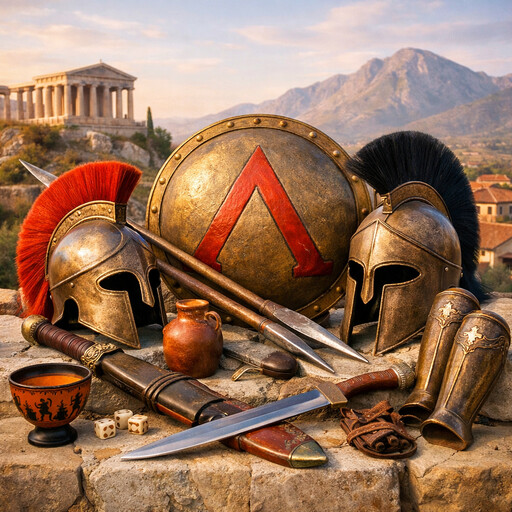
The land of Greece is mountainous and surrounded by sea. This geography affected how people lived. Many communities were separated by mountains, which made travel difficult. Because of this, city-states developed their own governments and laws. Important city-states included Athens, Sparta, Corinth, and Thebes. Each city-state had its own way of life. For example, Athens focused on learning and trade, while Sparta focused on military training.
Ancient Greek city-states used different forms of government. Some were ruled by kings. Others were ruled by small groups called oligarchies. Athens developed a system called democracy. Democracy means rule by the people. In Athens, some citizens could gather to vote on laws and decisions. Not everyone could take part. Women, slaves, and foreigners were excluded. Even so, this system was different from earlier forms of rule.
Religion was an important part of daily life in Ancient Greece. Greeks believed in many gods and goddesses. This belief system is called polytheism, which means belief in many gods. The gods were believed to live on Mount Olympus. Important gods included Zeus, the king of the gods; Athena, the goddess of wisdom; and Apollo, the god of music and healing. Religious festivals and temples were common in Greek cities.
Ancient Greece is also known for its art, literature, and thinking. Greek writers created epic poems, plays, and historical works. Homer is traditionally named as the author of the epic poems Iliad and Odyssey. Greek thinkers such as Socrates, Plato, and Aristotle asked questions about life, knowledge, and society. These thinkers are called philosophers. A philosopher is a person who studies ideas about truth and meaning.
The period known as the Classical Age lasted from about 500 BCE to 323 BCE. It included wars such as the Persian Wars and the Peloponnesian War. Later, Greece was united under Alexander the Great, who spread Greek culture across a wide area. In 146 BCE, Greece became part of the Roman Republic. Even after this, Greek language and culture continued to influence the Mediterranean world.
Ancient Greece
Level
readlittle.com
Early civilization of Greek city-states
What We Can Learn
- Ancient Greece was made up of independent city-states.
- Geography shaped Greek political and social life.
- Religion involved many gods and shared myths.
- Greek culture influenced later civilizations.