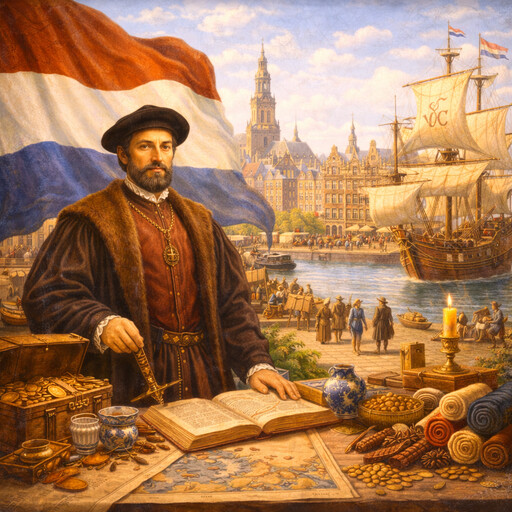
The Dutch East India Company was a powerful trading company from the Netherlands. Its Dutch name was Vereenigde Oostindische Compagnie, often shortened to VOC. It was founded in 1602. At that time, many European countries wanted to trade directly with Asia. Asian goods such as spices, silk, porcelain, and tea were valuable in Europe. The Dutch government allowed several small trading groups to join together into one company. This company was given special rights to trade, make agreements, and protect its ships. The Dutch East India Company became one of the strongest companies in world history.
The company was created to trade with lands in Asia, especially the islands of Southeast Asia. These islands are now part of countries such as Indonesia. Spices like pepper, nutmeg, and cloves grew there. In Europe, spices were used to flavor food and preserve meat. They were rare and expensive. The company built ships and sent them on long sea voyages. These voyages could take many months. Sailors crossed dangerous oceans and faced storms, disease, and hunger. Even so, the company earned large profits from trade.
The Dutch East India Company was not only a business. It also had powers usually held by governments. It could build forts, keep armies, and fight wars. It could also make treaties. A treaty is a formal agreement between groups or countries. The company set up trading posts and colonies. A colony is a place controlled by a distant country. One important center was Batavia, now called Jakarta, in Indonesia. From there, the company controlled trade routes and local rulers. This made the company very strong in the region.
The company’s ships traveled between Europe and Asia. They carried silver from Europe to Asia and brought back spices and other goods. The company also traded within Asia itself. It bought goods in one place and sold them in another. This helped it control prices. Over time, the company became very wealthy. It paid money to its investors. Investors are people who give money to a company to help it grow, hoping to earn more money later. The Dutch East India Company was one of the first companies to sell shares. Shares are small parts of a company that people can own.
Life in the company was not easy for workers or sailors. Many people died on long voyages. Local people in Asia often lost land or were forced to work for the company. The company used force to keep control of trade. It destroyed competing towns and punished people who resisted. Over time, the company became large but also corrupt. Corrupt means that leaders used power unfairly for personal gain. Costs rose, profits fell, and management became weak.
By the late 1700s, the Dutch East India Company was in trouble. Wars in Europe, competition from other countries, and poor management harmed the company. In 1799, the company was officially closed. Its lands and buildings were taken over by the Dutch government. Even after it ended, the company left a strong mark on history. It shaped trade, colonization, and contact between Europe and Asia. Its actions influenced many regions for centuries.
Dutch East India Company
Level
readlittle.com
Powerful trading company of the Netherlands
What We Can Learn
- The Dutch East India Company was founded in 1602 in the Netherlands.
- It controlled trade between Europe and Asia, especially spices.
- The company had powers like a government, including armies and treaties.
- It closed in 1799 after financial and management problems.
Related Reads
Atlantic slave trade
Forced movement of enslaved people across Atlantic
Triangular trade
Three-part trade route across the Atlantic
Dutch Golden Age
Period of Dutch global growth
East India Company
British trading company that ruled India
Treaty of Tordesillas
Dividing new lands between two kingdoms
Henry Hudson
Explorer of northern seas and rivers
Titanic
British passenger ship that sank in 1912

Capitalism
Economic system based on private ownership
David Ricardo
British thinker on trade and economy
Adam Smith
Scottish thinker of trade and economy
Dutch Republic
Independent republic in northern Europe

Mediterranean Sea
Sea between Europe, Africa, and Asia