Henry Hudson was an English sea explorer who lived around the late 1500s and early 1600s. He is remembered for several long ocean voyages in search of new sea routes. A sea route is a path ships use to travel across oceans. During Hudson’s time, European countries wanted faster ways to reach Asia to trade for goods such as spices and silk. Hudson sailed into cold and dangerous waters while trying to find a northern route to Asia. Even though he did not reach Asia, his journeys added important knowledge about northern lands and seas.
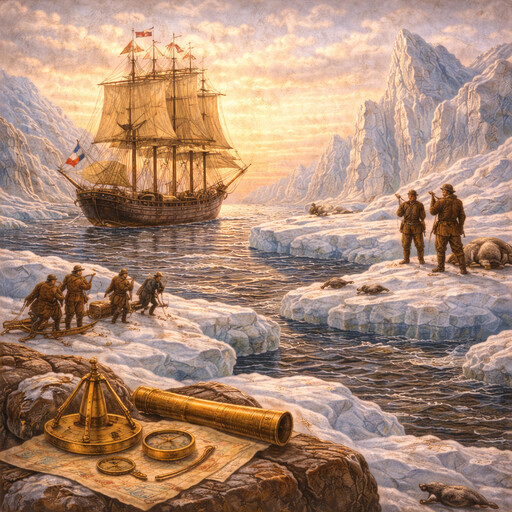
Very little is known about Henry Hudson’s early life. He was born in England, but the exact year and place are not certain. He became a ship captain and navigator. A navigator is a person who plans and guides a ship’s journey. In the early 1600s, England and other European nations paid explorers to search for new routes. These routes were called the Northwest Passage or the Northeast Passage. They were hoped to pass through or around the Arctic Ocean. Hudson believed such a route could exist, even though the seas were icy and hard to travel.
Henry Hudson made four major voyages between 1607 and 1611. On his first two voyages, he sailed for England. He traveled north toward the Arctic Ocean, near Greenland and the islands above Europe. He faced thick ice, freezing weather, and long periods of darkness. His ships could not break through the ice, and he had to turn back. Even so, Hudson carefully recorded what he saw, including coastlines, ice conditions, and wildlife such as whales.
On his third voyage in 1609, Hudson sailed for the Netherlands instead of England. The Dutch hoped he would find a route to Asia. During this journey, Hudson crossed the Atlantic Ocean and explored the eastern coast of North America. He sailed into a wide river that is now called the Hudson River. This river flows through what is now New York State. Hudson traveled far up the river, thinking it might lead to the Pacific Ocean. It did not, but his exploration helped the Dutch later settle in the area.
Henry Hudson’s final voyage began in 1610. He sailed again for England, searching for a Northwest Passage. He entered a large body of water in northern Canada, now called Hudson Bay. A bay is a wide area of water connected to an ocean. Hudson believed this bay might lead to Asia. His ship became trapped by ice during the winter. The crew had to stay on the ship for many months with little food. Conditions became very difficult.
In the spring of 1611, Hudson wanted to continue exploring, but his crew disagreed. They were tired, hungry, and wanted to return home. A mutiny occurred. A mutiny is when sailors rebel against their captain. Hudson, his son, and a few loyal crew members were placed in a small boat and left behind. They were never seen again. Even though his life ended this way, Henry Hudson’s name remains on rivers, bays, and regions he explored. His voyages helped improve maps and understanding of northern North America.
Henry Hudson
Level
readlittle.com
Explorer of northern seas and rivers
What We Can Learn
- Henry Hudson was an English explorer of the early 1600s.
- He searched for northern sea routes to Asia.
- He explored the Hudson River and Hudson Bay.
- His final voyage ended after a mutiny by his crew.
Related Reads
Triangular trade
Three-part trade route across the Atlantic
Cape of Good Hope
Southern headland of Africa
Mary Kingsley
British traveler and writer in West Africa
Perry Expedition
American naval mission to Japan
David Livingstone
Scottish explorer of Africa
Roald Amundsen
Norwegian polar explorer

Lewis and Clark Expedition
Exploring the land west of the Mississippi
Northwest Passage
A sea route through Arctic waters
Ida Laura Pfeiffer
A traveler who journeyed around the world
James Cook
British explorer of the Pacific Ocean
Sacagawea
Guide and interpreter of a western expedition

William Clark
Leader of a famous American exploration