The Dutch Golden Age was a period mainly in the 1600s when the Dutch Republic grew rich and powerful. During this time, the Netherlands became one of the leading regions in Europe. Dutch ships traveled across the world, cities expanded, and trade increased greatly. Art, science, and learning also developed quickly. The term “Golden Age” is used to describe this long period of growth and activity, which lasted for much of the seventeenth century.
The Dutch Golden Age began after the Netherlands gained independence from Spain. This independence followed a long conflict known as the Eighty Years’ War, which started in 1568. A war is a long period of fighting between groups or countries. By the early 1600s, the northern provinces formed the Dutch Republic. Unlike many European states, the Dutch Republic was not ruled by a king. Instead, it was governed by provinces and city leaders. This system allowed merchants and local officials to have strong influence.
Trade played a central role in the Dutch Golden Age. The Dutch built a large merchant fleet, which is a group of ships used for trade. Dutch ships carried goods such as grain, spices, cloth, and timber. The Dutch East India Company was founded in 1602. A company is an organization created to conduct business. This company traded with Asia and controlled ports and islands far from Europe. Another company, the Dutch West India Company, traded in the Americas and Africa. These trading networks brought wealth into Dutch cities such as Amsterdam.
Cities grew larger and more organized during this period. Amsterdam became one of the most important ports in Europe. A port is a place where ships load and unload goods. Banks, warehouses, and markets developed to support trade. The Dutch were also skilled in shipbuilding and navigation. Navigation is the practice of planning and directing ship travel. Dutch maps and charts were widely used. The economy supported many jobs, from sailors and craftsmen to traders and clerks.
The Dutch Golden Age is also known for advances in art and science. Painters such as Rembrandt van Rijn, Johannes Vermeer, and Frans Hals created detailed works showing daily life, portraits, and landscapes. These paintings often focused on ordinary people rather than kings or religious scenes. In science, Dutch thinkers made progress in areas such as astronomy, optics, and medicine. Optics is the study of light and lenses. Antonie van Leeuwenhoek used lenses to observe tiny living things, while Christiaan Huygens studied motion and time.
By the late 1600s and early 1700s, the Dutch Golden Age began to slow. Other countries, including England and France, grew stronger in trade and naval power. Wars and competition reduced Dutch influence. Even so, the period left a lasting mark on world history. The Dutch Golden Age shaped global trade routes, urban life, art styles, and scientific study. It remains an important chapter in the history of the Netherlands and early modern Europe.
Dutch Golden Age
Level
readlittle.com
Period of Dutch global growth
What We Can Learn
- Took place mainly during the 1600s
- Marked by strong global trade and shipping
- Included major growth in art and science
- Centered in the independent Dutch Republic
Related Reads
Antarctic Treaty System
Agreements governing Antarctica
Alexander von Humboldt
Explorer of nature and the natural world
East India Company
British trading company that ruled India
Botany
The study of plants and plant life
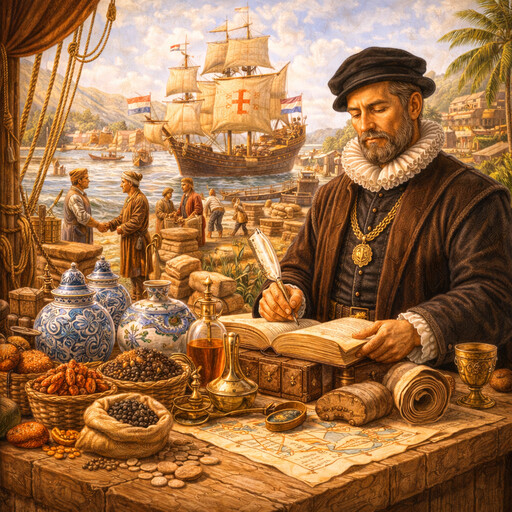
Dutch East India Company
Powerful trading company of the Netherlands

Capitalism
Economic system based on private ownership
Robert Koch
German doctor who studied disease-causing bacteria
Louis Pasteur
French scientist who studied germs
David Ricardo
British thinker on trade and economy
Adam Smith
Scottish thinker of trade and economy
René Descartes
Philosopher and mathematician of early science
Blaise Pascal
Mathematician and thinker of early science