Roald Amundsen was a Norwegian explorer who became one of the most important figures in polar exploration. He is best known as the first person to reach the South Pole. He reached it in December 1911, several weeks before any other expedition. Amundsen explored some of the coldest and least known places on Earth. These regions are called polar regions, meaning areas near the North Pole and South Pole. His journeys took place during a time when much of the Arctic and Antarctic had not yet been mapped. Amundsen planned carefully and focused on survival in extreme cold.
Roald Amundsen was born on 16 July 1872 in Borge, Norway. Norway is a country with a long coastline and a strong history of seafaring. His family worked in shipping and trade. As a young boy, Amundsen became interested in exploration after reading about earlier Arctic travelers. He later studied medicine, but he decided not to become a doctor. Instead, he trained as a sailor so he could take part in sea voyages. He learned navigation, which means finding direction at sea, and he gained experience in cold waters. These skills became important later in his life.
Amundsen’s first major expedition took place from 1897 to 1899, when he joined a Belgian Antarctic expedition. During this journey, the ship became trapped in ice, and the crew had to survive the winter in Antarctica. This experience taught Amundsen how dangerous polar travel could be. He learned the importance of warm clothing, good food, and careful planning. After returning home, he led his own expedition from 1903 to 1906. During this voyage, he became the first person to travel through the Northwest Passage. This is a sea route through the Arctic Ocean along the northern coast of North America.
Amundsen is most famous for his journey to the South Pole. In 1910, he sailed to Antarctica with a team of men and many sled dogs. At first, his plans were not fully known to the public. When he arrived in the Antarctic, he set up a base camp called Framheim. He studied the land and weather carefully. Amundsen used sled dogs to pull supplies and wore clothing based on Inuit designs. The Inuit are Indigenous people of the Arctic who have long experience living in cold climates. On 14 December 1911, Amundsen and four companions reached the South Pole and placed the Norwegian flag there.
After reaching the South Pole, Amundsen continued to explore polar regions. He turned his attention to the Arctic and new technology. In the 1920s, he became interested in air travel. Airships were large aircraft that could float and travel long distances. In 1926, Amundsen flew over the North Pole in the airship Norge, along with other explorers. This flight helped confirm the location of the North Pole and showed that aircraft could be used in polar exploration. It marked a new stage in the exploration of remote regions.
Roald Amundsen disappeared in 1928 during a rescue mission. He was flying in a seaplane while searching for another explorer whose airship had crashed in the Arctic. The plane never returned, and no clear evidence of what happened was found. Amundsen was declared dead later that year. His life was marked by long journeys, careful preparation, and work in extreme environments. He remains closely connected to the history of Arctic and Antarctic exploration.
Roald Amundsen
Level
readlittle.com
Norwegian polar explorer
What We Can Learn
- Roald Amundsen was the first person to reach the South Pole
- He was born in Norway in 1872
- He traveled through the Northwest Passage
- He later explored the Arctic using airships
Related Reads
Mary Kingsley
British traveler and writer in West Africa
David Livingstone
Scottish explorer of Africa
Perry Expedition
American naval mission to Japan
Antarctic Treaty System
Agreements governing Antarctica
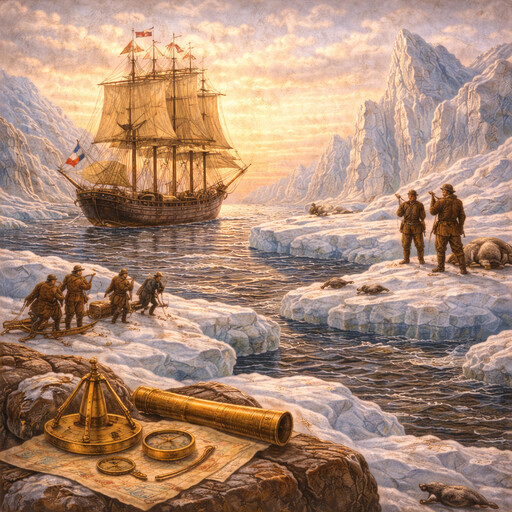
Northwest Passage
A sea route through Arctic waters
Francis Xavier
Missionary who traveled across Asia

Lewis and Clark Expedition
Exploring the land west of the Mississippi
Sacagawea
Guide and interpreter of a western expedition

William Clark
Leader of a famous American exploration
John Franklin
British explorer of the Arctic
Ida Laura Pfeiffer
A traveler who journeyed around the world
Henry Hudson
Explorer of northern seas and rivers